What Is the Türkiye Tech Visa?
Türkiye Tech Visa 2025: The Complete Guide for Tech Professionals, Startup Founders & Entrepreneurs" meta_description: "Everything you need to know about the Türkiye Tech Visa — eligibility, benefits, application process, tax exemptions, and why Turkey's booming startup ecosystem is attracting global tech talent in 2025."
5/12/202622 min read
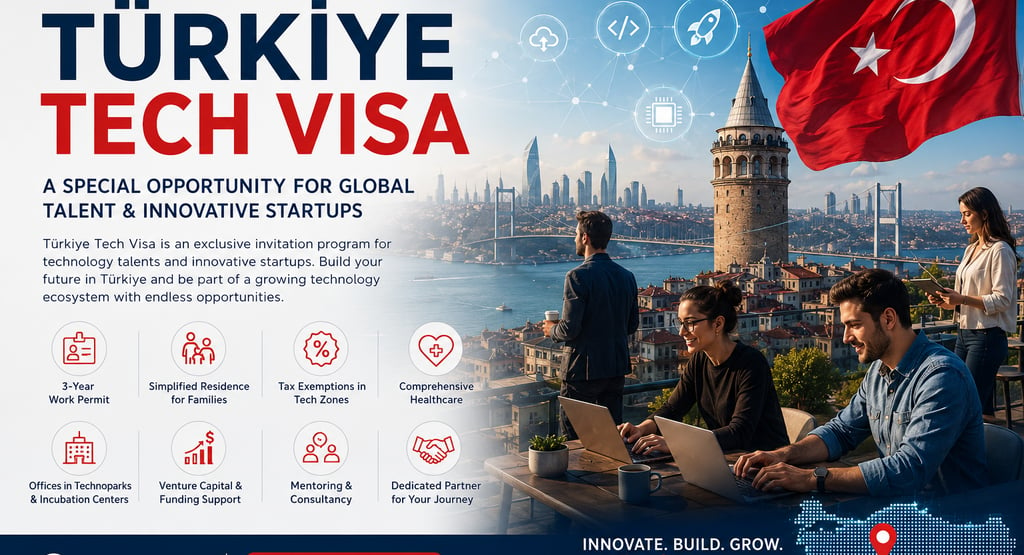
Türkiye Tech Visa: Your Gateway to One of the World's Most Dynamic Tech Ecosystems
A comprehensive guide for software engineers, startup founders, AI specialists, and digital professionals considering Turkey's bold new invitation to the world's tech talent.
There is a moment in every emerging tech hub's story when the world stops dismissing it and starts paying attention. For Turkey, that moment arrived in September 2024 — when the Ministry of Industry and Technology officially launched the Türkiye Tech Visa, a specialized work permit program designed to attract the world's most innovative minds to one of the planet's most strategically positioned nations.
This is not a generic immigration scheme dressed up in startup language. The Türkiye Tech Visa is a structured, government-backed initiative with tangible incentives: income tax exemptions, subsidized social security, dedicated office spaces in innovation zones, six months of free legal and financial consultancy, and a three-year work permit that gives professionals the runway to build something meaningful without bureaucratic interruption.
At a time when talent is arguably the most critical resource in the global technology race, Turkey is making a calculated and ambitious move — positioning itself not as a peripheral player, but as a genuine hub at the nexus of Europe, Asia, and the Middle East.
This guide explores everything you need to know about the Türkiye Tech Visa: who qualifies, what you gain, how the application works, what the challenges look like on the ground, and why a growing number of international tech professionals are putting Istanbul on their relocation shortlist.
What Is the Türkiye Tech Visa?
Launched officially on September 16, 2024, the Türkiye Tech Visa is, in the government's own words, "an exclusive invitation program for talents with critical expertise in technology and startups with innovative business models and technology-based studies."
The program falls under the oversight of Turkey's Ministry of Industry and Technology and operates in coordination with the Ministry of Labour and Social Security. It creates a dedicated, fast-tracked pathway for two categories of foreign nationals: individual tech talents (employed professionals) and startup entrepreneurs (founders seeking to establish or scale innovative ventures).
Unlike a standard Turkish work permit, which is issued routinely to foreign employees of Turkish companies, the Tech Visa comes bundled with a comprehensive support ecosystem — tax benefits, healthcare assistance, workspace access, mentorship, and a concierge-style onboarding experience designed to help international talent integrate quickly and productively.
The vision is unambiguous: Turkey wants to be a global technology hub. It has the infrastructure, the geography, the young demographic profile, and the growing capital market to make that case. What it needed was a formal mechanism to signal to the world that international talent is not just tolerated — it is actively sought.
Why Turkey Launched This Initiative
Turkey's technology ambitions did not emerge overnight. Over the past decade, the country has built an increasingly serious innovation infrastructure — 101 technoparks hosting more than 8,000 companies, over 1,500 R&D centers employing some 200,000 researchers, and more than 200 universities contributing to advanced technology programs. Global giants including Microsoft, SAP, and Huawei have established R&D centers in Turkey, not as secondary outposts but as substantive operations.
The ecosystem has also produced results. Trendyol, Turkey's e-commerce powerhouse, reached a valuation of approximately $15 billion and stands as one of the largest mobile commerce platforms in the MENA region. Dream Games, known globally for Royal Match, proved that Turkish gaming studios can compete at the highest level. Insider, backed by Sequoia Capital, became a B2B SaaS leader valued at over $1 billion. From a single unicorn a decade ago, Turkey has graduated to producing a generation of globally competitive tech companies with a combined startup ecosystem value exceeding $30 billion.
Yet Turkish officials recognized a gap: while homegrown talent is strong, a truly world-class tech hub requires diversity of thought, international networks, and cross-pollination of ideas. The Tech Visa is designed to bridge that gap — importing talent that will collaborate with, mentor, and elevate Turkey's domestic tech workforce.
As Industry and Technology Minister Mehmet Fatih Kacır put it at the program's launch: the Türkiye Tech Visa "serves as a cornerstone in the country's journey to establish itself as a leader in global technology."
Who Can Apply for the Türkiye Tech Visa?
The program targets two distinct profiles, each with its own application pathway and support structure.
Individual Tech Talents
This pathway is designed for employed professionals — people who have been hired by a Turkish company operating in technology or research and development. The types of expertise the program is looking for reflect the full spectrum of modern tech:
Software engineers and developers are a natural fit. Whether your specialization is full-stack web development, mobile applications, cloud architecture, or systems programming, Turkey's growing portfolio of tech companies — from early-stage startups to multinational R&D centers — creates genuine demand for software talent.
Artificial intelligence and machine learning specialists are among the most sought-after profiles globally, and Turkey is no exception. With a National AI Strategy (2021–2025) in place and AI startups leading Turkish funding rounds — raising $715.8 million in 2024 alone — the country is actively investing in building AI capacity.
Cybersecurity professionals occupy a specific area of national priority. Turkey has been building regional influence in cyber defense, and its software companies are increasingly positioning themselves as significant regional players in the security space.
Data scientists and analytics engineers are in demand across every industry vertical that has established a footprint in Turkey's tech zones, from fintech to health tech to logistics.
Hardware engineers, robotics specialists, and defense technology professionals find a uniquely supportive environment in Turkey, where the success of indigenous drone technology — particularly the Bayraktar TB2 — has demonstrated the depth and ambition of the country's engineering culture.
Startup Entrepreneurs
The second pathway is for founders: people building innovative, technology-based companies. The program explicitly welcomes "startups with innovative business models and technology-based studies," which is broad by design — Turkish officials want founders operating across the full range of modern tech verticals, not just software.
Likely qualifying profiles include SaaS founders building B2B platforms, fintech entrepreneurs developing payment infrastructure or lending technology, blockchain developers creating Web3 applications, gaming studio founders, health tech innovators, and e-commerce technology builders.
Crucially, the program also streamlines the work permit process for startup founders — reducing the bureaucratic obstacles that have historically made it cumbersome to establish and operate a new company in Turkey as a foreign national.
To qualify broadly, applicants are expected to hold relevant higher education credentials (a degree or equivalent certification in a related field), demonstrate sufficient income (income requirements have been cited at around $3,000 per month for digital professionals), and carry a passport valid for at least six months beyond the planned entry date.
Key Benefits of the Türkiye Tech Visa
A Three-Year Work Permit — and What That Actually Means
The headline benefit is a work permit valid for up to three years — significantly longer than the typical one-year permits issued under standard processes. For a software engineer joining a Turkish tech company, or a startup founder establishing a new venture, this extended runway is meaningful. It eliminates the anxiety of annual renewals and allows genuine long-term planning: hiring, product development, fundraising, and personal life decisions can all be made with a stable legal foundation.
The Ministry of Labour and Social Security issues the permit following an initial work visa application through a Turkish embassy or consulate. The process is described as deliberately streamlined compared to the standard work permit pathway.
Income Tax Exemption in Technology Development Zones
One of the most financially significant benefits is the exemption from income tax for professionals working in Turkish technology development zones, commonly known as technoparks. If your employer operates within a designated technopark — and the majority of Turkey's most advanced tech employers do — you pay zero income tax on the income generated from R&D and software development activities.
For a mid-to-senior software engineer or a startup founder drawing a salary, this exemption can translate into thousands of dollars of additional annual income. Combined with Turkey's already lower cost of living compared to Western Europe, the effective purchasing power advantage is considerable.
Corporate tax exemptions also apply to companies conducting R&D activities in these zones, meaning startup founders establishing Turkish entities benefit from a favorable tax environment at the company level as well.
State-Subsidized Social Security and Healthcare
The Turkish state covers 50% of social security premiums for Tech Visa holders, including access to comprehensive healthcare services. Turkey's healthcare infrastructure — particularly in Istanbul and Ankara — is genuinely strong, with well-equipped hospitals, internationally trained physicians, and a national health system that provides broad coverage.
For international professionals accustomed to expensive private health insurance in markets like the United States or the United Kingdom, state-subsidized healthcare represents a meaningful quality-of-life improvement.
Simplified Residence Permits for Family Members
Relocating internationally is rarely a solo decision. The Tech Visa program includes streamlined pathways for family members — spouses and children — to obtain residence permits, reducing the bureaucratic complexity that typically accompanies international moves with families. This is a deliberate signal from the Turkish government that it wants tech talent to arrive and stay, not just visit.
Access to Technopark Offices and Innovation Infrastructure
Turkey's 101 technoparks — spread across all 81 provinces — are more than just tax-advantaged addresses. They are innovation ecosystems in their own right: purpose-built campuses with modern office infrastructure, collaboration spaces, shared laboratories, and direct connections to university research departments.
Tech Visa holders gain access to office opportunities within these parks, as well as incubation centers and co-working facilities. For early-stage founders in particular, access to this infrastructure — without the cost of establishing independent office space — dramatically reduces the overhead of setting up in a new market.
Istanbul's ITÜ Arı Teknokent, ODTÜ Teknokent in Ankara, and Bilkent Cyberpark are among the most prominent and well-connected technoparks, each with deep ties to leading Turkish universities and multinational corporate tenants.
Six Months of Legal and Financial Consultancy
Startup founders admitted under the Tech Visa program receive six months of dedicated legal and financial consultancy from the Ministry of Industry and Technology. This is a substantial practical benefit — navigating Turkish company formation laws, tax registration, labor regulations, and intellectual property protections can be genuinely complex, and professional guidance during the critical first months of operation can prevent costly mistakes.
This consultancy is provided as part of the program, not billed to the applicant — making it particularly valuable for founders who are capital-conscious in the early stages of building their businesses.
Venture Capital and Startup Funding Access
Turkey's venture capital market has matured significantly. The country is now home to 278 venture capital funds of various sizes, and Istanbul is firmly established as the primary hub for startup investment in the region. Total transaction volume for Turkish startups soared from $497 million in 2023 to approximately $2.6 billion in 2024 — a 423% increase in a single year.
Tech Visa holders plugging into this ecosystem gain access to a growing pool of capital, from pre-seed angel networks to growth-stage institutional funds. Prominent active investors include 212, Revo Capital, Earlybird, and a range of sector-specific funds focused on gaming, fintech, and SaaS.
Mentoring and Ecosystem Connectivity
Perhaps less quantifiable but equally important is access to Turkey's growing network of mentors, accelerators, and ecosystem events. Istanbul hosts a dense calendar of startup conferences, pitch events, hackathons, and investor meetings. Organizations like Startupbootcamp Istanbul, Techstars Istanbul, and the Istanbul Development Agency actively support early-stage founders. The program's onboarding support is designed to connect incoming talent with these networks from day one.
Why Turkey Is Becoming Attractive for Tech Professionals
Geographic Position: The World's Most Underappreciated Advantage
Turkey occupies a genuinely extraordinary geographic position. Istanbul sits at the intersection of Europe and Asia — within a three-hour flight of over 60 countries, including the entirety of the European Union, the Gulf states, Central Asia, and North Africa. For a startup founder thinking about market expansion, this is not a geographic footnote; it is a strategic asset.
Companies that establish a base in Istanbul can realistically serve European, Middle Eastern, and Central Asian markets from a single operational center. This is a positioning advantage that neither Amsterdam nor Dubai can fully replicate, and it is one of the most compelling structural arguments for Turkey's emergence as a regional tech hub.
Cost of Living: Meaningfully Lower Than Western Europe
For international tech professionals accustomed to the costs of London, Amsterdam, Berlin, or Paris, Istanbul represents a significant quality-of-life upgrade at lower cost. A comfortable one-bedroom apartment in a central Istanbul neighborhood typically costs a fraction of an equivalent London flat. Restaurant meals, transport, and daily expenses are similarly more affordable, even after accounting for recent inflation trends in the Turkish economy.
This cost differential matters most for early-stage founders managing burn rates and runway — and for companies hiring international teams on competitive global salaries while keeping operational costs manageable.
Young, Educated, and Digital-Native Population
Turkey is, as the official program materials correctly note, the largest and youngest country in Europe by population — 85 million people with a median age of 32. More than 8 million students are currently enrolled in higher education, and over 1.2 million graduates enter the workforce annually.
This demographic profile creates both a supply of skilled local collaborators and a large, digitally engaged consumer market. Turkey's internet penetration and mobile commerce adoption rates have positioned it as one of the most digitally active markets in the region — a natural testing ground for consumer tech products.
Government Commitment to Innovation
The level of institutional support for technology in Turkey is striking. The National AI Strategy, the Deneyap technology workshops operating across all 81 provinces, the dedicated General Directorate of National Technology and Artificial Intelligence, and the ambitious Terminal Istanbul project — a plan to repurpose the historic Atatürk Airport into a global hub for startups and technology events — all reflect a government that has made technology leadership a genuine national priority, not a policy afterthought.
Rapid Growth in Strategic Sectors
Turkey's fintech sector has produced companies like Papara, the digital financial services platform that became a unicorn, and Midas, a fintech startup that has raised $137 million and attracted significant investor attention. The gaming industry, already home to dozens of studios valued above $100 million, continues to grow — with Istanbul ranked second in Europe for game studios behind London. Health tech, logistics technology, and defense technology are additional verticals where Turkish companies are building globally competitive products.
Turkey's Technology Ecosystem in Depth
Istanbul: A Startup Hub With Global Rankings
Istanbul has made an extraordinary leap in global startup ecosystem rankings. In the Startup Genome Global Startup Ecosystem Report, Istanbul climbed to the No. 3 position globally in the Emerging Startup Ecosystem category in 2025 — a jump of 10 places compared to the previous year. The Dealroom Global Tech Ecosystem Index 2025 ranked Istanbul second worldwide among comparable markets.
The city's ecosystem value has reached $12.9 billion. Six unicorns call Istanbul home: Getir, Peak Games, Dream Games, Trendyol, Hepsiburada, and Insider. Hepsiburada made history as the first Turkish company to list on the Nasdaq, offering a blueprint for Turkish founders with global public market ambitions.
The Technopark Network
Turkey's 101 technoparks represent a genuinely differentiated infrastructure advantage. These are not simply tax-advantaged office parks — they are integrated innovation environments with direct university partnerships, government funding pipelines, and multinational corporate tenants who run global R&D operations from Turkish soil. More than 100 global companies have established R&D centers in Turkey, many of them within the technopark network.
By the end of 2025, 667 companies had earned the official "Tech Startup Badge" certification — a government verification system designed to help innovative firms access public funding and investment. The country's competency badge portal has issued 400,000 certificates to 225,000 recipients, reflecting the scale of the credentialing and support infrastructure.
Accelerators and the Investment Ecosystem
Turkey's accelerator and incubator landscape has matured considerably. Startupbootcamp Istanbul, Techstars Istanbul, and the programs run by KOSGEB (the Small and Medium Enterprises Development Organization) provide early-stage founders with structured support, mentorship, and access to investor networks.
Turkey's 278 VC funds span the full investment lifecycle — from pre-seed angel networks to growth-stage institutional funds with hundreds of millions of euros under management. The 2024 regulation of Venture Capital Investment Funds enabled VCIFs to invest in startups operating in both Turkey and abroad, with special emphasis on Turkish diaspora-led ventures — a smart policy that both expands capital availability and strengthens ties with the global Turkish tech community.
Priority Sectors
Gaming leads in terms of exit velocity and international recognition, but the strongest growth opportunities for incoming talent span a broader range of sectors. Fintech benefits from Turkey's large unbanked and underbanked population and sophisticated mobile payment culture. E-commerce continues to scale, anchored by Trendyol's dominance and sustained demand for marketplace infrastructure and logistics technology. SaaS is a priority vertical for multiple Turkish VC funds, particularly B2B platforms targeting regional markets. AI and data analytics are cross-cutting themes affecting every sector. Health tech and logistics technology represent emerging verticals with strong government support and growing private capital interest.
How Türkiye Tech Visa Compares to Other Global Programs
The global competition for tech talent has produced a range of visa programs, each with different structures, costs, and value propositions. Here is how the Türkiye Tech Visa positions itself in that competitive landscape.
Canada Startup Visa
Canada's Startup Visa requires endorsement from a designated organization — a venture capital fund, angel investor group, or business incubator — and a minimum qualifying investment of CAD $75,000 from a VC fund or CAD $25,000 from an angel network. Processing times have historically ranged from 12 to 39 months. It leads to permanent residency, which is a significant long-term advantage, but the front-loaded requirements and processing delays make it challenging for founders who need to move quickly.
Türkiye vs. Canada: Turkey's process is faster and less financially prescriptive on entry. Canada wins on long-term settlement path and ecosystem maturity.
Portugal Tech Visa
Portugal's Tech Visa is aimed at technology company professionals and requires a sponsoring Portuguese company, proof of relevant qualifications, and income above the national minimum wage. Portugal offers the advantage of EU market access and a path to Portuguese citizenship, which carries significant global mobility value. However, Portugal's startup ecosystem is smaller than Turkey's, and Lisbon's cost of living has risen sharply in recent years.
Türkiye vs. Portugal: Turkey's ecosystem is larger and more dynamic, its tax incentives in technoparks are more generous, and its market access — particularly to the Middle East and Central Asia — is unique. Portugal wins on EU membership and eventual EU passport access.
UAE Golden Visa
The UAE's Golden Visa provides long-term residency (5 or 10 years) to investors, entrepreneurs, and specialized talent. Dubai in particular has become a global tech hub with zero income tax, world-class infrastructure, and strong international business connectivity. However, the UAE's cost of living — particularly in Dubai — has increased significantly, and the talent ecosystem is largely expat-driven rather than rooted in local entrepreneurial culture.
Türkiye vs. UAE: Turkey offers a more organically developed startup ecosystem with stronger local talent depth. The UAE's zero income tax is a structural advantage, though Turkey's technopark exemptions significantly narrow the gap for qualifying professionals. Turkey's cost of living advantage over Dubai is considerable.
UK Innovator Founder Visa
The UK's Innovator Founder Visa requires endorsement from an approved body, a genuinely innovative business idea assessed as viable and scalable, and a £50,000 investment fund. The UK's ecosystem advantages — access to London's deep capital markets, a mature startup culture, and strong multinational connectivity — are significant. But the visa's cost, the endorsement requirement, and the UK's high cost of living (particularly London) create meaningful barriers.
Türkiye vs. UK: The UK has a deeper and more mature ecosystem, but Turkey offers a more accessible entry point, lower operating costs, and stronger tax incentives for technology-focused entrepreneurs.
Estonia Digital Nomad Visa
Estonia's digital nomad visa is arguably the most accessible of these programs — Estonia has built its e-Residency ecosystem into a genuinely innovative brand for remote professionals. However, Estonia's domestic market is small, its startup ecosystem is limited in depth, and it functions primarily as a gateway to the EU rather than a market in its own right.
Türkiye vs. Estonia: Turkey offers a vastly larger domestic market, a richer local ecosystem, and stronger emerging market access. Estonia wins on EU legal frameworks and e-residency infrastructure.
The Step-by-Step Application Process
Step One: Determine Your Pathway
The first decision is whether you are applying as an individual tech talent (employed by a Turkish tech company) or as a startup entrepreneur (establishing or operating your own technology company). The application pathways differ slightly, though both involve the same government ministries.
Step Two: Apply for a Work Visa at a Turkish Consulate
The process begins at a Turkish embassy or consulate in your country of residence. You apply for a work visa — indicating that you are applying under the Tech Visa program — and submit your initial documentation package, which is expected to include:
A valid passport (minimum six months validity beyond your planned entry date)
Proof of relevant academic qualifications (degree or equivalent certification in a technology-related field)
Evidence of income or financial capacity (bank statements showing at least $3,000 per month for digital professional applicants)
Employment offer or company documentation (for talent applicants, a job offer from a Turkish tech company; for founders, documentation of the business being established)
A business plan or project description (particularly important for startup founders)
Curriculum vitae demonstrating relevant technology expertise
Step Three: Work Permit Application to the Ministry of Labour
Following the work visa, the applicant — or their sponsoring employer — submits a work permit application to Turkey's Ministry of Labour and Social Security. The Tech Visa designation triggers an expedited review process. The Ministry evaluates the applicant's profile against the program's eligibility criteria, with particular attention to technological expertise, business model innovation (for founders), and the alignment of the applicant's work with Turkey's technology development priorities.
Step Four: Approval and Onboarding
Upon approval, the Ministry issues a work permit valid for up to three years. Startup founders are then enrolled in the six-month consultancy support program, which provides dedicated legal, financial, and operational guidance to help establish and operate their ventures effectively.
The Ministry of Industry and Technology's Tech Visa portal (turkiyetechvisa.gov.tr) serves as the central information and application hub, with the registration function managed through the turkiyetechvisa.sanayi.gov.tr subdomain.
Estimated Timeline
Given that this program was launched in September 2024 and was actively approving applications through 2025 — with 22 foreign startups officially approved for relocation by early 2026 — processing timelines are still being established. Early indications suggest the process is meaningfully faster than Turkey's standard work permit pathway, though applicants should plan for a process of several weeks to a few months from initial application to work permit issuance.
Common Mistakes to Avoid
Submitting incomplete documentation. The most common reason for delays in immigration applications globally is missing or inadequate documentation. Assemble a complete, organized package before submitting.
Underestimating the business plan requirement. For startup founders, a vague or generic business plan will not distinguish your application. Demonstrate specific knowledge of the Turkish market, clear technological differentiation, and a credible path to commercialization.
Ignoring the corporate structure question. Founders should understand early whether they are establishing a Turkish limited company (limited şirketi) or operating through another legal structure. This affects tax treatment, banking, and the legal consultancy support you will receive.
Failing to engage with the ecosystem before arriving. The most successful international founders in any market arrive with connections already made — investors, potential partners, potential customers. Attend Istanbul startup events virtually, join Turkish tech communities online, and warm up your network before you land.
Challenges and Realities
No honest guide to relocating for professional purposes can ignore the difficulties. Turkey is a compelling opportunity — but it is not without friction.
Language
Turkish is a non-Indo-European language with a grammar structure fundamentally different from English, Spanish, French, or German. While Istanbul's tech community is largely English-speaking, and most major corporations and startups operate effectively in English, navigating daily life — government offices, landlords, banks, medical appointments — requires either Turkish proficiency or reliable translation support. The good news: Turkey's large and active expat community in Istanbul has developed a robust support infrastructure, and language-learning resources are widely available.
Economic Volatility
Turkey has experienced periods of significant currency volatility in recent years. For professionals earning in foreign currency (USD or EUR), this is not a concern — your international purchasing power benefits from the exchange rate differential. For professionals earning Turkish lira, currency fluctuations create income uncertainty that requires careful financial planning. Founders raising capital from Turkish investors in lira should model conservative exchange-rate scenarios.
Market Adaptation
Turkish business culture has specific characteristics that differ from Western European or North American norms — relationship-building is central to deal-making, hierarchical structures are common in established companies, and patience is often required in enterprise sales cycles. Founders targeting the Turkish domestic market should invest in cultural fluency, not just market research.
Legal and Tax Compliance
Turkey's legal and regulatory environment for foreign businesses has improved significantly but remains complex in areas. The six-month consultancy support provided under the Tech Visa is specifically designed to address this — but founders should not expect to operate effectively without qualified local legal and accounting counsel. This is particularly true in areas like labor law, IP registration, and VAT compliance.
Competition
Turkey's growing attractiveness means its ecosystem is becoming more competitive. The local talent market in Istanbul is tighter than it was three years ago, particularly for senior software engineers. Founders should plan to recruit both locally and internationally, and should price their compensation packages with the realities of the market in mind.
Startup Opportunities in Turkey: Where the Growth Is
Fintech
Turkey's fintech sector is among the most active in the broader MENA and Eastern European region. A large population with sophisticated mobile payment habits, significant segments that remain underserved by traditional banking, and a regulatory environment that has been progressively adapted to support financial innovation create a compelling opportunity set. Payment infrastructure, digital lending, wealth management technology, and insurance technology (insurtech) are all areas of active development and investment.
Gaming
Istanbul ranks second in Europe for game studios behind London — a remarkable achievement for a market that has, in under a decade, produced globally distributed games with tens of millions of players. Dream Games' Royal Match became one of the most downloaded mobile games in the world. The ecosystem supporting gaming founders is unusually well-developed: gaming-specific VC funds, specialized accelerators, and a deep pool of game development talent make Turkey one of the world's premier destinations for gaming startup founders.
AI and Data Analytics
Turkish AI startups led all sectors in funding volume in 2024, attracting $715.8 million. The national AI strategy and a growing number of AI-focused university research programs are building the human capital and institutional infrastructure to sustain this momentum. Cross-sector AI applications — in healthcare, finance, logistics, and customer engagement — represent the most active areas of market development.
E-Commerce and Logistics Technology
Trendyol's rise to a $15 billion valuation validated Turkey's potential as an e-commerce market at scale. The infrastructure required to support e-commerce growth — last-mile delivery technology, warehouse management systems, supply chain software, and cross-border logistics platforms — remains an area of active investment and innovation. Turkey's position as a trade corridor between Europe and Asia gives logistics technology companies access to genuinely global supply chains.
Health Technology
Turkey's healthcare system is large, well-funded by regional standards, and undergoing active digital transformation. Telemedicine, digital diagnostics, patient management platforms, and pharmaceutical technology represent growing verticals. Government procurement in healthcare technology is an active channel for Turkish health tech companies.
SaaS
B2B SaaS is a consistent priority for Turkish VC funds, and for good reason: Turkish software companies targeting European and MENA enterprise markets can compete on quality while maintaining structural cost advantages. Insider's journey from Istanbul to a Sequoia-backed unicorn is the clearest illustration of this thesis.
The Future of Türkiye Tech Visa
By early 2026, the program had officially approved 22 foreign startups for relocation — a modest but meaningful beginning. The General Directorate of National Technology has been restructured to include a specific mandate for artificial intelligence, reflecting the government's recognition that AI is the defining technology challenge of the coming decade.
The Terminal Istanbul project — converting the historic Atatürk Airport terminal buildings into a campus for more than 2,000 startups, with multiple annual events and international programming — represents Turkey's most ambitious statement of intent yet. If realized, it would create a physical and symbolic center of gravity for Turkey's tech ecosystem that few cities in the world can match.
The medium-term ambitions are clear: Turkey's startup ecosystem has climbed to the No. 3 position globally in the Emerging Startup Ecosystem category (Startup Genome, 2025), and the government's stated goal is continued ascent in global rankings. Total VC investment over four years has exceeded $6.4 billion, surpassing the global average growth rate.
For international tech professionals and startup founders, the practical implication is this: Turkey is in an early-mover window. The ecosystem is established enough to be credible, dynamic enough to offer real opportunity, and still accessible enough that incoming talent can establish a meaningful position before the market fully matures. The companies that built foundational positions in Singapore in the 2000s or Lisbon in the early 2010s understood this logic — and the Türkiye Tech Visa is Turkey's invitation to make that bet now.
Conclusion: An Invitation Worth Taking Seriously
The Türkiye Tech Visa is not a vanity program. It is a structured, incentive-rich immigration pathway backed by institutional infrastructure, genuine tax benefits, and a government with a track record of delivering on its technology commitments.
Turkey brings to this moment a unique combination of assets: geographic centrality that gives founders access to multiple high-growth markets from a single base, a young and digitally sophisticated population, a startup ecosystem that has already produced unicorns and decacorns across multiple sectors, and a cost structure that allows international talent to maintain high quality of life while keeping operational costs competitive.
The challenges are real — language, economic volatility, legal complexity, cultural adaptation — but these are challenges that any serious professional can navigate with preparation, good counsel, and the willingness to engage authentically with a new market.
What Turkey is offering, through the Tech Visa, is not just a work permit. It is an invitation to be part of a story that is still being written — a country at an inflection point, with ambitions that match its geography, its demographics, and the energy of its entrepreneurial community.
For the software engineer looking for a market where their skills are valued and their purchasing power stretches. For the startup founder seeking a base that offers emerging market access with developed market infrastructure. For the investor looking for the next ecosystem before the rest of the world catches up: the case for Turkey is getting harder to ignore.
The Türkiye Tech Visa is the door. What you build on the other side is up to you.
Frequently Asked Questions
1. What is the Türkiye Tech Visa and when was it launched?
The Türkiye Tech Visa is a specialized work permit program launched on September 16, 2024, by Turkey's Ministry of Industry and Technology. It is an invitation-based program for foreign nationals with critical technology expertise and startup founders with innovative business models.
2. Who is eligible to apply for the Türkiye Tech Visa?
The program is open to two groups: individual tech professionals (software engineers, AI specialists, cybersecurity experts, data scientists, and other technology specialists) employed by Turkish technology companies, and startup entrepreneurs establishing innovative technology-based businesses in Turkey. A relevant higher education degree and demonstrated income of at least $3,000 per month are among the baseline requirements.
3. How long is the work permit issued under the Tech Visa?
The Türkiye Tech Visa work permit is valid for up to three years — significantly longer than Turkey's standard one-year work permits.
4. What are the tax benefits for Tech Visa holders?
Professionals working in Turkey's designated technology development zones (technoparks) are exempt from income tax on income generated from R&D and software development activities. Companies operating in these zones also benefit from corporate tax exemptions. The state additionally covers 50% of social security premiums, including healthcare, for qualifying Tech Visa holders.
5. Does the Türkiye Tech Visa include support for family relocation?
Yes. The program includes simplified residence permit pathways for family members of Tech Visa holders, facilitating the relocation of spouses and children.
6. What consultancy support is provided to startup founders?
Startup founders admitted under the Tech Visa program receive six months of dedicated legal and financial consultancy from the Ministry of Industry and Technology, designed to help them navigate Turkish company formation, tax registration, and operational compliance.
7. Does the Türkiye Tech Visa lead to Turkish citizenship?
The Tech Visa is a work permit, not a direct citizenship pathway. However, Turkey has a separate Citizenship by Investment program, with a minimum investment threshold of $400,000. Long-term legal residence may also create eligibility for naturalization under standard Turkish immigration law, though specific pathways from the Tech Visa to citizenship have not been officially detailed.
8. What is Turkey's startup ecosystem ranking globally?
Istanbul climbed to the No. 3 position globally in the Emerging Startup Ecosystem category in the Startup Genome Global Startup Ecosystem Report 2025 — a 10-place jump from the previous year. The Dealroom Global Tech Ecosystem Index 2025 ranked Istanbul second worldwide among comparable markets. The city's ecosystem value has reached $12.9 billion.
9. How do I apply for the Türkiye Tech Visa?
The process begins with a work visa application at a Turkish embassy or consulate, followed by a work permit application to Turkey's Ministry of Labour and Social Security. The central information portal is at turkiyetechvisa.gov.tr. Applicants should prepare documentation including proof of qualifications, evidence of income, employment offers or company documentation, and a business plan (for founders).
10. What are the key sectors for startup opportunities in Turkey?
The most active and high-opportunity sectors include fintech, mobile gaming, AI and data analytics, e-commerce and logistics technology, health tech, B2B SaaS, and cybersecurity. Turkey's gaming sector is particularly notable — Istanbul ranks second in Europe for game studios, behind London only.
This article reflects information available as of May 2026. Visa program details, eligibility requirements, and application procedures may evolve. Prospective applicants should consult official Turkish government sources and qualified immigration advisors for the most current information.